Latte art is more than decoration - it's a sign of well-executed espresso and milk texture. In Los Angeles, a city ranked as the 3rd top coffee destination in the U.S. (2026), latte art reflects the diverse techniques and influences shaping its coffee culture. From classic designs like hearts and rosettas to advanced free-pour creations and etched masterpieces, each style tells a story of craftsmanship and creativity.
Here’s a quick breakdown of the most popular latte art styles in LA:
- Classic Rosetta: A fern-like pattern requiring precision and quick wrist movements. It’s a staple for skilled baristas and a symbol of expertise.
- Hearts & Tulips: Simpler designs ideal for beginners. These are quick to pour and perfect for high-paced cafes.
- Advanced Free-Pour Designs: Complex patterns like swans or peacocks that showcase artistic skill but are harder to replicate during busy service.
- Etched Latte Art: Detailed designs created with tools, offering playful visuals but taking more time to execute.
Each style balances artistry, technical skill, and practicality, making LA’s coffee scene both dynamic and diverse. Whether you prefer a quick heart or an Instagram-worthy swan, the best coffee shops in LA have something for every coffee lover.
Latte Art Tutorial - 7 Most Popular Latte Art Designs
sbb-itb-1d31003
1. Classic Rosetta
The rosetta is the latte art design that likely comes to mind for most people - a fern-like pattern with layered petals radiating from a central stem. This iconic design was named in 1992 by David Schomer of Espresso Vivace in Seattle, inspired by a photo taken at Cafe Mateki in Italy. It has since become a staple in specialty coffee shops across Los Angeles, admired for its precision and visual appeal.
Visual Complexity
A well-executed rosetta stands out with its sharp contrast between the white microfoam and the dark crema. Any blurriness or lack of contrast often indicates issues with either the espresso or milk texture - or both.
Technical Difficulty
The rosetta is no walk in the park for baristas. It demands quick, precise wrist movements and careful control of milk temperature (ideally between 140–155°F). Milk heated beyond 165°F becomes too thick to flow properly, making the design nearly impossible. For beginners, mastering the rosetta can take over 100 practice pours spread across weeks to build the muscle memory required for a clean, recognizable pattern.
"The rosetta is the ultimate pattern for combining efficiency and detail. It combines three pitcher maneuvers - and two of these, shaking and fishtailing, are difficult to learn." - Barista Hustle
Consistency in Service
Despite its complexity, seasoned baristas often rely on the rosetta during busy shifts. Once mastered, it can be poured in under five seconds, showcasing both skill and efficiency - qualities that are highly valued in fast-paced coffee service.
Cultural and Aesthetic Appeal
In Los Angeles, the rosetta holds a special place in the coffee community. David Schomer reflected on its significance:
"In 1989, Lisa Persons learned how to pour a perfect heart, and then I developed the rosetta later. After that, latte art became a worldwide artisan signature for people trying to make coffee a culinary art." - David Schomer, Co-owner, Espresso Vivace
In a city known for its vibrant coffee culture, the rosetta has become a symbol of craftsmanship and creativity. Its enduring popularity bridges the gap between tradition and innovation, inspiring baristas to push the boundaries of latte art while staying rooted in classic techniques.
2. Hearts and Tulips
If the rosetta is considered the advanced level of latte art, hearts and tulips are where most baristas take their first steps - and where many Los Angeles cafes find their daily rhythm. These designs simplify the process without losing the artistic charm that makes latte art so appealing.
Visual Complexity
The heart is the simplest and most iconic latte art design. It’s created by pouring a white circle of milk onto the crema, then cutting through the center to form two curved lobes and a pointed bottom. The tulip takes this a step further by layering multiple rounded “bulbs” (usually 3 to 5) to create a tiered, floral design. Both patterns are visually striking because of the bold contrast between the white microfoam and the dark crema. Their clean, recognizable shapes make them favorites among baristas and customers alike.
Technical Difficulty
Compared to the intricate rosetta, hearts and tulips are much more approachable for beginners. Hearts focus on mastering pour height and flow control without requiring the rapid wrist movements needed for more complex designs. To create a heart, start pouring from about 1.5–2.5 inches above the cup, allowing the milk to sink beneath the crema. Then, lower the pitcher to 0.2–0.4 inches to make the design appear.
The tulip builds on this technique by adding a "lift-pause-drop" motion between each layer, ensuring the bulbs remain distinct. As Jacob Yaze from OneHundredCoffee explains:
"Latte art isn't just decoration. It's basically your espresso's 'report card.' If your milk texture is wrong, the art won't work."
For the best results, milk should be steamed to a temperature between 140–155°F.
Consistency in Service
Tulips are especially practical in busy cafes. Unlike the rosetta, which requires continuous wrist movement that can be hard to sustain during peak hours, the tulip’s stop-and-start method is more forgiving. Each “push” acts as its own mini-pour, meaning a small mistake in one layer won’t necessarily ruin the entire design. This makes the tulip a go-to choice in fast-paced Los Angeles coffee shops, where efficiency and quality are both non-negotiable.
"The tulip... is a popular pattern because it is easy for a barista to pour well while working under time pressure." - Barista Hustle
Cultural and Aesthetic Appeal
Hearts and tulips aren’t just about technique - they carry emotional and artistic significance. The heart conveys warmth and friendliness, while the tulip’s layered design showcases a barista’s precision and intent. Together, they reflect the care and effort poured into every cup. As Equipoise Coffee puts it:
"Latte art transforms your morning routine into a creative experience, with each cup showcasing intricate patterns that reflect a barista's skill and imagination."
In Los Angeles, where coffee culture is as much about personal expression as it is about the drink itself, even a simple 3-layer tulip can set a cafe apart. Many of the spots featured on Best Coffee Shops in Los Angeles proudly highlight their baristas’ craftsmanship, with hearts and tulips often serving as the first sign of their expertise.
3. Advanced Free-Pour Designs
Once baristas have mastered hearts, tulips, and rosettas, they can take their skills to the next level with advanced free-pour designs. These intricate patterns demand a combination of technical precision and artistic creativity.
Visual Complexity
Advanced free-pour designs often blend multiple techniques to create detailed illustrations. Take the swan, for example - it combines a multi-layered tulip body, a free-poured curved neck, and a heart-shaped head. Similarly, a peacock design uses layers of rosetta "feathers" surrounding a central body. To achieve these striking patterns, baristas rely on crema that’s at least 1 mm thick and milk that’s glossy and free of bubbles. This level of detail requires exceptional control over both the milk and the pour.
Technical Difficulty
Creating these designs isn’t just about artistry; it’s about precision. Baristas need to control the cup's angle, adjust the height of the pour, manage the speed, and execute precise wrist movements with a wiggle frequency of 5–7 Hz (a small, rapid motion of about 0.4–0.8 inches). One of the toughest parts is transitioning from a high pour (1.5–2.5 inches above the cup) to a low pour (0.2–0.4 inches) as the cup nears 60% full.
Gabriele, a trainer at Espresso Academy, highlights the challenge:
"The true challenge for a barista lies in Free Pouring - creating complex figures solely through direct pouring. This skill requires months of practice and a deep understanding of fluid dynamics."
Many baristas follow rigorous routines, such as a "100-pour practice plan", to perfect these transitions. Even with practice, replicating these designs consistently in a busy café setting adds another layer of difficulty.
Consistency in Service
Maintaining consistency during high-volume service is no small feat. Milk must be used quickly - within 30 seconds - or it begins to separate. Baristas often swirl the pitcher vigorously to re-incorporate microfoam before pouring. For advanced designs, the milk temperature must stay between 140°F and 155°F to maintain the perfect foam texture.
Jack Benchakul, co-owner of Endorffeine, exemplifies the dedication required for consistency. In April 2026, he became the first coffee professional in 35 years of James Beard Foundation awards to be named a finalist for Outstanding Professional in Beverage Service. Benchakul is the only person allowed to pull espresso shots at his shop, where he meticulously controls variables like humidity and water pH to ensure a flawless crema canvas.
Cultural and Aesthetic Appeal
Beyond their technical demands, advanced free-pour designs are a celebration of coffee culture and artistry. On May 2, 2007, Intelligentsia Coffee hosted the first public latte art "smackdown" at its LA roastery. This bracket-style competition highlighted the creativity and skill of latte art. Kyle Glanville, who was Intelligentsia's Director of Innovation at the time, not only organized the event but also won the $360 cash prize.
"It was the most ridiculous spectacle, and it was great." - Kyle Glanville, Co-founder of G&B Coffee
This event is credited with sparking the modern latte art throwdown culture, which remains a vibrant part of the specialty coffee scene. Advanced free-pour designs are more than just a technical achievement - they’re a public display of craftsmanship, reflecting the quality and care that go into every cup.
4. Etched Latte Art
Etched latte art takes coffee presentation to another level by adding intricate designs after the pour. Unlike free-pour techniques, this method uses tools like latte art pens, toothpicks, or needles to shape steamed milk into detailed creations.
Visual Complexity
Etching allows for designs that go far beyond what can be achieved with free-pouring. Think cat whiskers, expressive eyes in a portrait, or even elaborate shapes like a praying mantis or a bull with hay - details that are impossible to achieve with milk flow alone. Baristas often enhance these designs with food-safe colorings or chocolate sauce to add shading and contrast, making the art even more visually striking.
Technical Difficulty
Creating etched latte art requires precision and speed. The foam - a delicate mix of crema and microfoam - starts to break down within seconds. To get the best results, the milk must be textured to a "wet paint" consistency. If it's over- or under-frothed, the etched lines can blur. The milk temperature also plays a key role; keeping it between 150°F and 155°F helps maintain the foam's stability. A simple 2D etched design usually takes about 5 minutes, while more intricate 3D designs can take up to 7 minutes.
"Etching... is great for creativity, but it does not replace foundational pouring skills." - Rock Creek Coffee Roasters
Consistency in Service
Because of the time it takes to create these designs, etched latte art is best suited for slower-paced or specialty service settings. In busy environments, the process can easily cause delays.
Cultural and Aesthetic Appeal
The "Art Bar" category at the World Latte Art Championship (held in April 2026 in San Diego) highlighted the whimsical and creative side of etching. Designs included a praying mantis, a puppy playing with a soccer ball, and Garfield the cat, showcasing the playful spirit of LA's coffee culture.
"Art Bar is where things get a little bit wacky... They're judged based on creativity and appearance." - Amy Ball, Digital Content Director, Specialty Coffee Association
This style of latte art is all about turning a cup of coffee into a personalized masterpiece. It’s less about the science of milk flow and more about crafting something visually delightful - a quality that resonates with LA's social media-savvy, visually focused coffee enthusiasts.
Pros and Cons of Each Style
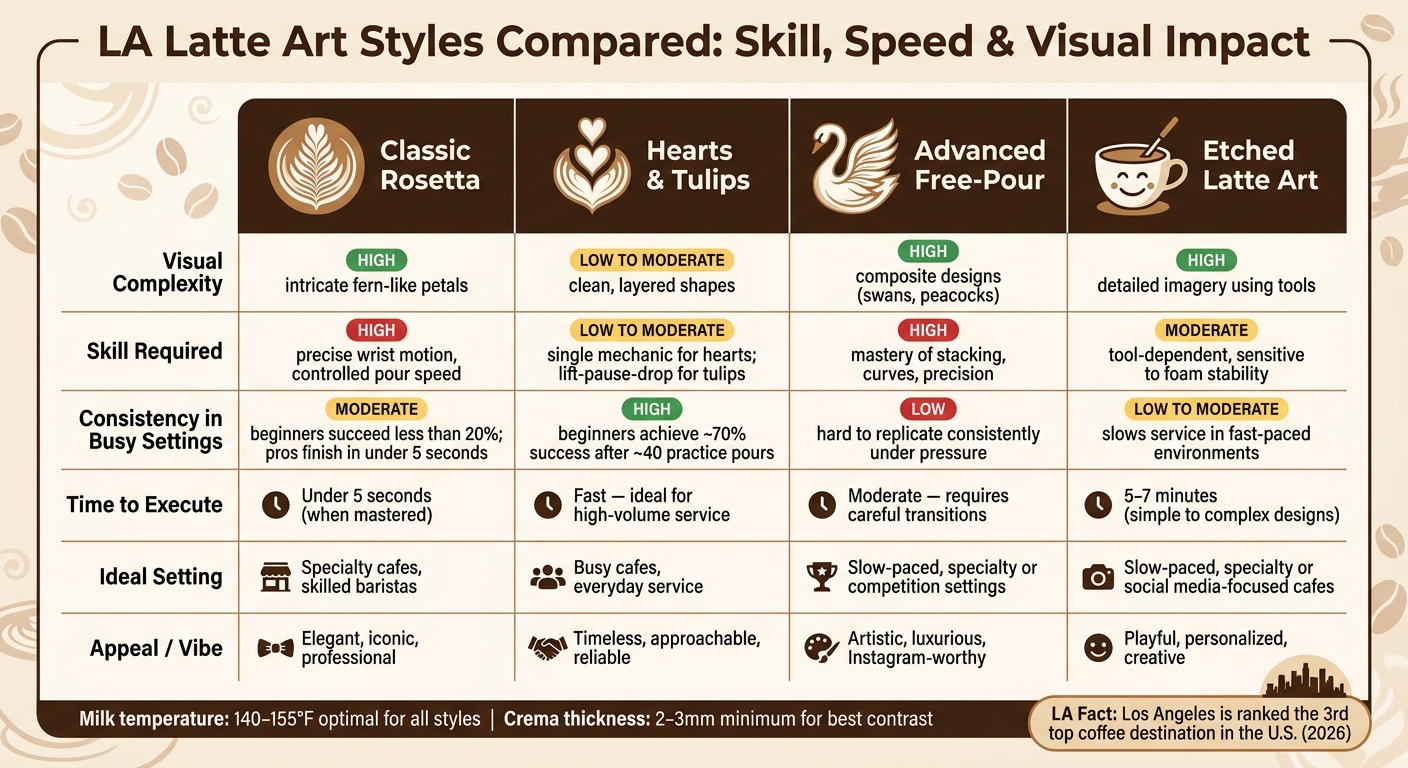
LA Latte Art Styles Compared: Skill, Speed & Visual Impact
Each latte art style carries its own strengths and challenges. While some designs shine in the relaxed atmosphere of a specialty café, they can fall short during the chaos of a busy weekend morning. Below is a breakdown of how the four styles perform across key factors:
| Style | Visual Complexity | Skill Required | Consistency in Busy Settings | Appeal |
|---|---|---|---|---|
| Classic Rosetta | High - intricate, fern-like petals | High - demands precise wrist motion and controlled pour speed | Moderate - beginners often succeed less than 20% of the time; professionals can complete one in under 5 seconds | Elegant, iconic, professional |
| Hearts & Tulips | Low to Moderate - clean, layered shapes | Low to Moderate - hearts use a single mechanic; tulips require a "lift-pause-drop" rhythm | High - beginners achieve about 70% success with hearts after roughly 40 practice pours | Timeless, graphic, approachable |
| Advanced Free-Pour | High - composite designs like swans or peacocks | High - mastery of stacking, curves, and precision is essential | Low - hard to replicate consistently in high-pressure settings | Artistic, luxurious, Instagram-worthy |
| Etched Latte Art | High - detailed imagery created using tools | Moderate - relies on tools and is sensitive to foam stability | Low to Moderate - the process slows service in fast-paced environments | Playful, personalized, creative |
In Los Angeles cafés, where innovation intersects with the demands of fast service, these trade-offs highlight the evolution of latte art. The table emphasizes the balance between visual appeal and the practicalities of service, helping determine which designs suit the bustling pace of LA coffee culture.
Heart and Tulip styles stand out in busy settings due to their simplicity and reliability. These designs also serve as a marker of well-textured milk. Joel Gargaro from Rock Creek Coffee Roasters explains:
"A clean heart or tulip usually means your milk was textured properly... the design is often proof that the drink itself is on the right track." - Joel Gargaro, Rock Creek Coffee Roasters
Meanwhile, the Classic Rosetta, though visually stunning and a hallmark of skill, is sensitive to minor inconsistencies in rhythm and flow. Advanced Free-Pour and Etched designs are better suited for slower-paced, specialty environments. These are the kinds of spaces celebrated on Best Coffee Shops in Los Angeles, where baristas can take their time to perfect their craft and explore creative possibilities.
One crucial factor to note: a crema layer at least 2–3 mm thick is essential for maintaining contrast in latte art designs.
Conclusion
Every latte art style has its own charm and purpose, making the "best" choice all about personal preference. Hearts and tulips are perfect for busy mornings - they’re quick to pour, reliable, and show that the milk was steamed just right. On the other hand, the classic rosetta is a true test of a barista’s skill, requiring precise wrist movements and steady rhythm that only come with practice.
If you're after a drink that’s Instagram-worthy, advanced free-pour designs or etched art are the way to go. These intricate patterns grab attention but are better suited for slower-paced environments where baristas can take their time. While visually stunning, they don’t match the speed and efficiency of simpler designs.
"A well-poured design signals that the espresso was pulled properly, the milk was steamed with care, and the barista took time to craft something beautiful." - Gakii Mugendi
For those who appreciate technical artistry, specialty coffee shops are the best bet - they provide the space for baristas to experiment and showcase their creativity. But for the everyday coffee drinker, a clean heart or tulip is more than enough. It’s quick, reliable, and a clear sign of well-textured milk.
Whether you’re drawn to precision, creativity, or practicality, each latte art style reflects a different aspect of the craft. And in a city like Los Angeles, there’s no shortage of options to match your coffee preferences.
FAQs
Why does latte art say anything about espresso quality?
Latte art showcases the harmony between well-extracted espresso and perfectly textured milk. A rich, stable crema acts as the canvas, indicating that the espresso was pulled correctly. The milk, on the other hand, needs to be steamed into a silky microfoam - smooth and velvety, not dry or bubbly. Together, these elements not only enhance the drink's flavor and texture but also highlight the barista's skill and precision in achieving consistency and technique.
What milk and espresso settings help latte art show up clearly?
For creating sharp and defined latte art, begin with a robust espresso shot topped with thick, reddish-brown crema - it provides the perfect contrast. Use cold whole milk and steam it to a temperature between 140–155°F. The goal is to achieve a glossy texture with fine, velvety microfoam.
Once steamed, swirl and gently tap the milk pitcher to eliminate bubbles and ensure a smooth consistency. Start pouring from a higher position to mix the milk with the coffee. Then, lower the pitcher close to the surface - about 0.5 to 1 cm - to carefully craft your design.
What latte art style should I order during a busy rush?
During a busy rush, stick with a classic rosetta. It’s fast for baristas to pour and still looks great. Skip intricate custom designs - they take longer and can slow down the flow of service.