A coworking cafe membership usually means paying for a better work setup than a normal coffee shop, but less than a full office. In most cases, I’d expect Wi‑Fi, power, shared seating, and coffee or tea, with prices that often range from $25–$50 for a day pass or about $120–$450+ per month depending on access and desk type.
Before I join, I’d look at five things first:
- What I get: Wi‑Fi, outlets, shared tables, lounge areas, and sometimes printing
- What costs more: meeting rooms, guest passes, parking, lockers, mail service, and extra print pages
- When I can use it: many lower-cost plans only cover business hours, not nights or weekends
- How often I’ll go: day passes can cost less if I only need the space fewer than 10–12 days a month
- What the rules say: auto-renewal, notice periods, late fees, guest limits, and call policies
In plain terms, I’d treat a coworking cafe plan like a work tool, not just a place to sit. The low monthly price can look good at first, but the actual cost depends on access hours, add-on fees, and whether the space works for calls, focus, and my commute.
Quick comparison
| Option | Usual Cost | Best For | Common Limits |
|---|---|---|---|
| Regular cafe visit | Cost of food/drink | Short, casual work sessions | No seat promise, spotty Wi‑Fi, few outlets |
| Coworking cafe membership | $25–$50/day or $120–$450+/month | Freelancers, remote workers, hybrid schedules | Shared seating, lower privacy, extra fees |
| Full coworking office | Higher monthly cost | People who need desks, rooms, and office services | Less cafe feel, more fixed terms |
If I were comparing plans, I’d focus on total monthly cost, access hours, call setup, and cancellation rules before anything else.
What Memberships Typically Include
Most coworking cafe memberships cover the same core stuff. The main difference is the tier you choose and which extras come with it.
Workspace Basics: Wi-Fi, Seating, Power, and Shared Areas
Most memberships include fast, reliable Wi‑Fi, hot desks, shared tables, lounge seating, power outlets, and shared kitchens or quiet zones.
Outlets are often easy to find. Still, it’s smart to check the outlet-to-desk ratio in person. Some spaces simply have fewer outlets than seats, which can get annoying fast if you’re working on a laptop all day.
Common Perks: Coffee, Printing, Meeting Rooms, and Guest Access
Most plans come with drip coffee, tea, and filtered water. Printing and scanning are often available too, but there’s usually a monthly cap. Go over that limit, and you’ll likely pay a per-page fee.
Meeting room access is common, but the way it works changes by plan. Higher-tier memberships often include free credits, while lower-tier plans usually charge by the hour. Phone booths, when a space has them, are often tighter on budget plans and easier to access on premium plans. Some spaces also throw in member events.
What Is Usually Not Included by Default
Specialty drinks, snacks, and meals usually cost extra. Mail handling and a business address usually require a virtual office add-on, often starting at around $75 per month. Parking, lockers, and equipment insurance usually cost extra too.
That’s often where the monthly price shifts. A plan may look cheap at first, then climb once you add the things you need.
Use this quick breakdown to see what’s usually included and what tends to cost more.
| Feature | Typically Included | Often Extra or Restricted |
|---|---|---|
| Refreshments | Drip coffee, tea, filtered water | Specialty drinks, snacks |
| Meeting Rooms | Member rates, sometimes limited credits | Additional hours or higher-tier access |
| Access Hours | Standard business hours | 24/7 or weekend access |
| Storage | None | Lockers, mail handling |
| Guests | Limited access | Guest passes or booked meeting-room time |
| Printing | Limited monthly quota | Pages beyond quota (per-page fee) |
sbb-itb-1d31003
Pricing, Plan Types, and Access Limits
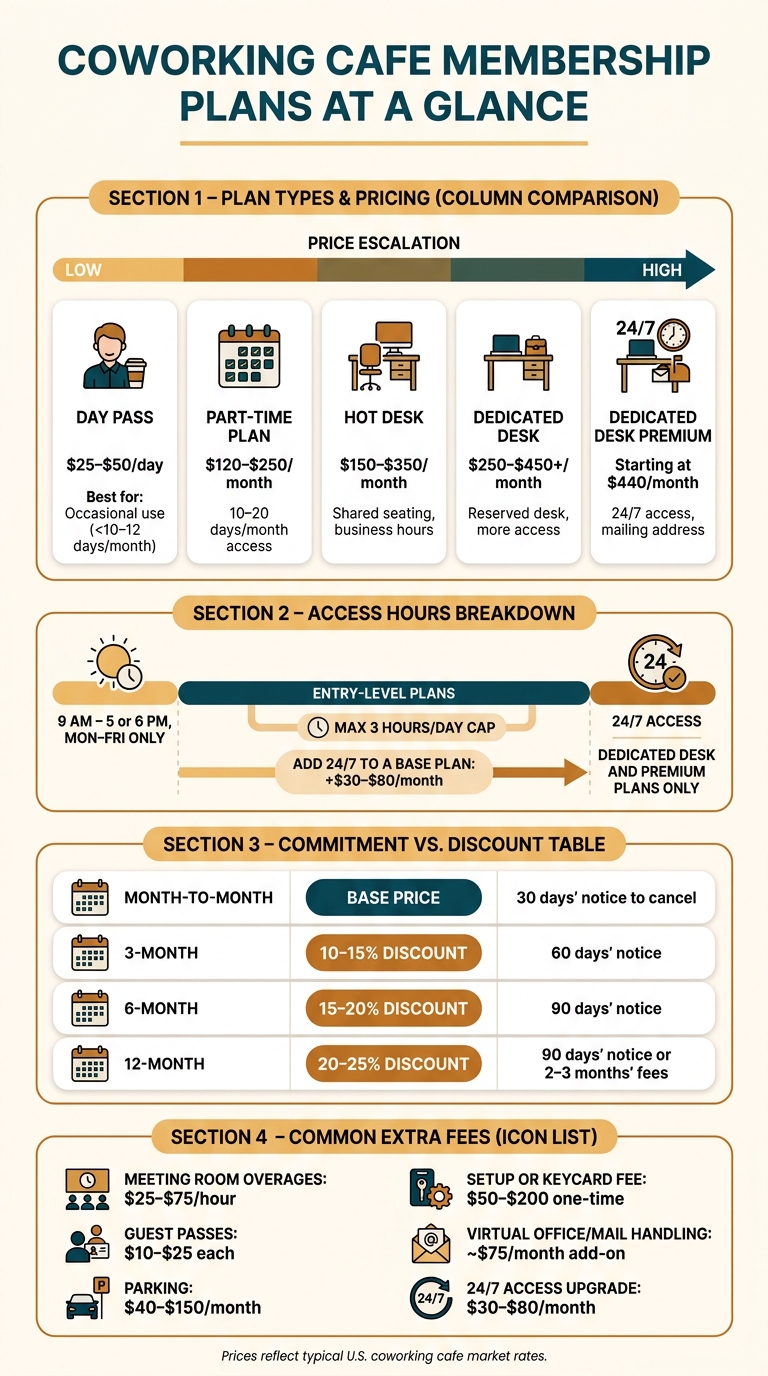
Coworking Cafe Membership Plans: Cost, Access & Features Compared
Once you know what’s included, compare plans based on access, hours, and total fees. In most spaces, the more access you want, the more you’ll pay. Extra hours, added perks, and add-ons can push the price up fast.
Day Passes, Monthly Plans, and Longer Commitments
A day pass is the simplest way to get in the door. It usually covers basic workspace access. In the U.S., day passes usually cost $25–$50.
If you only use a coworking space a few times each month, this option can make more sense. In many cases, if you go fewer than 10–12 days a month, day passes are cheaper than paying for a monthly plan.
Monthly memberships usually come in three main tiers:
- Hot desk: $150–$350/month
- Dedicated desk: $250–$450+/month
- Part-time access plans: $120–$250/month for 10–20 days a month
Longer commitments often lower the monthly rate, but there’s a catch: stricter cancellation terms.
| Commitment | Typical Discount | Typical Cancellation Terms |
|---|---|---|
| Month-to-month | Base price (highest) | 30 days' notice |
| 3-month | 10–15% discount | 60 days' notice or 1-month fee |
| 6-month | 15–20% discount | 90 days' notice or early termination fee |
| 12-month | 20–25% discount | 90 days' notice or 2–3 months' remaining fees |
Source:
Business Hours, Part-Time Plans, and 24/7 Access
Most entry-level plans don’t give you unlimited access. They usually stick to standard business hours, often 9:00 AM–5:00 PM or 6:00 PM, Monday through Friday. Some plans are even tighter and limit use to business hours or just three hours per day.
That matters more than people think. A plan may look cheap at first glance, but it’s a poor fit if you work early, stay late, or need weekends.
24/7 access is usually saved for dedicated desk and private office plans. If your base plan doesn’t include it, adding it often costs another $30–$80/month. And even when a space says 24/7 access is included, that access is often tied to your home location only, not every site in the network.
Extra Charges Members Should Expect
The monthly rate is only part of what you may end up paying. Common add-ons include meeting room overages at $25–$75/hour, guest passes at $10–$25, parking at $40–$150/month, and setup or keycard fees of $50–$200. Some spaces also ask for a security deposit.
That’s why the sticker price doesn’t tell the whole story. Small fees, short guest limits, or tight billing terms can change the actual cost in a big way. Before you join, check the cancellation window, guest rules, and billing terms closely.
Policies and Fine Print to Review Before Joining
Policies can change what a membership actually costs and what daily use feels like. After price and access hours, look at how billing works and what happens if you need to cancel.
Billing Terms, Renewals, and Cancellation Windows
Most memberships auto-renew monthly and charge in advance, usually on the 1st of the month or on your signup anniversary. If you join in the middle of a month, see whether that first payment is prorated. In many cases, membership fees are non-refundable, and you won't get credit for unused time.
Cancellation rules can be all over the map. Some spaces ask for notice by the day before the next billing date. Others ask for 30 days' notice on month-to-month plans and 60 days' notice on 6- or 12-month terms.
Late payments can add up too. Some operators charge a 10% late fee and give a five-day grace period before they suspend access. Others allow only one late-payment warning in a 12-month period before they cancel the membership. If you're on the road a lot, check for a pause option. Some plans let you pause for up to 45 days per year, but you lose access during that time.
House Rules for Noise, Calls, Guests, and Food Purchases
Daily rules matter just as much as billing terms. Coworking cafes tend to run with more structure than a normal cafe, and that shows up fast once you start using the space.
Calls are often limited to phone booths or meeting rooms, and some spaces limit booth use to one hour per session. If you're watching or listening to anything, you'll usually need headphones. Loud or disruptive behavior is typically not allowed.
Guest rules are often tight. Many spaces allow only short visits in lounge areas, and using a dedicated workspace may mean buying a day pass. Food policies vary too. Some spaces ban outside food and drinks, while others have shared kitchens where members can store and label their own items. In some cafe-style spots, there's also a minimum purchase requirement.
Once you know the rules, it's easier to compare plans by price, access hours, and contract length.
How to Compare Membership Plans and Choose the Right One
Compare plans by total value, not just the sticker price. A lower-cost plan with a tight daily cap can end up costing more than a higher-tier desk once you start using it often. Use the table to build a shortlist, then visit the space yourself before you pay.
Comparison Table: Price, Amenities, Access Hours, Contract Length, and Fees
The table below compares sample plans by price, access, and desk type.
| Plan Type | Monthly Price | Access Hours | Daily Limit | Key Amenities | Best For |
|---|---|---|---|---|---|
| Café Plan | Starting at $99 | Business hours | 3 hrs/day | Unreserved seat, Wi-Fi | Occasional drop-ins |
| Flex Coworking | $99 | Varies | Varies | Shared workspace, Wi-Fi | Hybrid remote workers |
| Touchdown Space | Starting at $199 | Business hours | None | Unreserved desk, Wi-Fi | Daily hybrid workers |
| Unlimited Coworking | $149 | Varies | Varies | Shared workspace, Wi-Fi | Full-time remote workers |
| Dedicated Desk (standard) | $299 | Varies | None | Reserved desk | All-day work |
| Dedicated Desk (premium) | Starting at $440 | 24/7 | None | Reserved desk, mailing address | Full-time professionals |
If you're in Los Angeles, put location near the top of your list. A space within a 10-minute walk or with easy Metro access can make day-to-day use much easier. And if you take four or more video calls each week, a plan with private phone booths isn't a nice extra - it's part of the job.
What to Check in Person Before Paying
Once the pricing looks good, test the space itself. Numbers on a website only tell part of the story. Visit during your normal work hours and check:
- Noise: Noise above 70 decibels can hurt focus
- Wi-Fi: Run a speed test at the seat you'd actually use. Aim for at least 25 Mbps download, 10 Mbps upload, and latency under 50 ms
- Outlets: Check outlet placement at your exact seat, not just somewhere nearby
- Booth access: Ask about the booth-to-member ratio. One booth per 20 members is a fair benchmark
- Commute: Confirm parking or Metro access. In LA, parking can add about $40/month to your total cost
Conclusion: The Key Terms That Matter Most
After you compare the terms and test the space, pick the plan that matches your schedule, call volume, and commute. A low advertised price can fall apart fast if access hours are limited, extra fees stack up, or the workspace isn't comfortable for a full day of work. If you're still looking at areas around the city, Best Coffee Shops in Los Angeles can help you browse work-friendly cafes by neighborhood and atmosphere before you commit to a membership.
FAQs
Is a day pass cheaper?
Usually, yes - if you use a coworking space fewer than 8 to 10 days a month.
Day passes often cost $25 to $50, so the break-even point compared with a monthly membership tends to land at about 6 to 12 visits.
Go more often than that, and a monthly membership will usually give you better long-term value.
It’s also smart to factor in extra costs like food, drinks, and parking.
What fees are usually not included?
Standard memberships usually include Wi-Fi, utilities, and furniture. But that doesn’t mean everything is covered.
It’s common to pay extra if you go over your printing or meeting room limits, bring in guests, or use add-ons like parking, lockers, IT or AV support, and concierge services.
Your own business liability insurance usually isn’t part of the membership either. Check your agreement for these added costs.
How can I tell if a plan fits my work style?
Match the membership to your day-to-day work, how often you work, and what keeps you on track. If you go in less than two days a week, a day pass or hybrid plan may cost less.
If your work calls for deep focus, client meetings, or privacy, look for private offices or dedicated desks. If you just need a spot for short tasks or more casual creative work, a cafe might do the job. It also helps to check the Wi-Fi, meeting rooms, ergonomic gear, and whether the bump in output is worth the price.