Barista work is hard on both the body and the mind at the same time. In one of the best coffee shops in Los Angeles, a barista may serve 150–200 customers in one shift, while dealing with sore wrists, hot equipment, rush stress, and customer pressure.
Here’s the short version:
- Physical strain often comes from standing 6–8 hours, repeated tamping, lifting milk and supplies, and working in tight spaces.
- Mental strain often comes from rush-hour multitasking, order tracking, split-second choices, and staying calm with customers.
- The two sides feed into each other: body pain can hurt focus, and stress can slow recovery after work.
- Common problems include upper-body injuries (55%), persistent muscle soreness (37%), high stress (44%), and anxiety attacks (29%).
- What helps most is simple: better layout, task rotation, break timing, clear shop systems, enough staff, and manager check-ins.
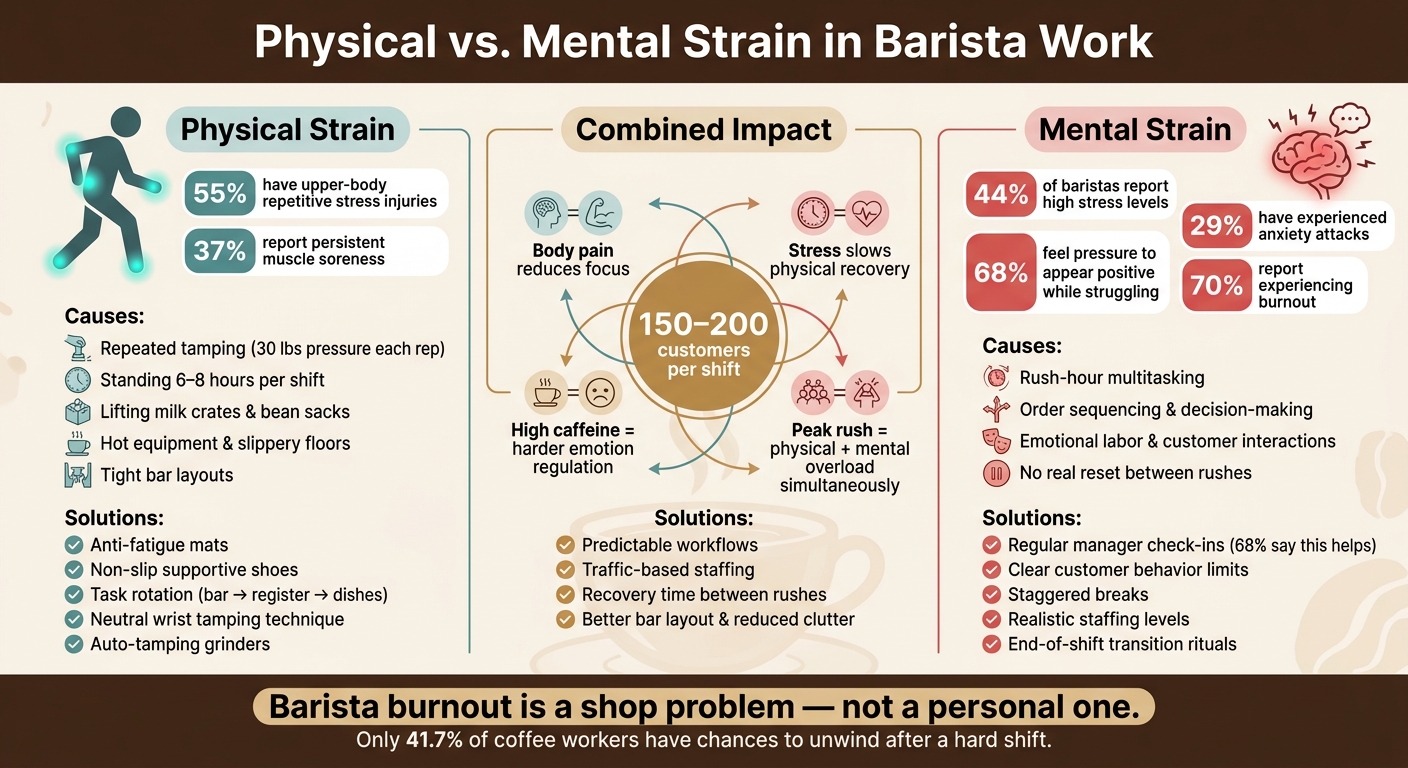
Physical vs. Mental Strain in Barista Work: Key Stats & Solutions
10 Things I Wish I Knew Before I Became A Barista
sbb-itb-1d31003
Quick Comparison
| Type | What it looks like | Main causes | What helps |
|---|---|---|---|
| Physical | Wrist pain, back pain, sore feet, fatigue | Repeated motions, lifting, long standing, heat, wet floors | Anti-fatigue mats, non-slip shoes, better station setup, task rotation |
| Mental | Stress, burnout, poor focus, emotional drain | Rushes, multitasking, customer issues, staying upbeat all shift | Clear systems, enough staff, breaks, check-ins, limits on customer behavior |
| Both together | More mistakes, slower reactions, exhaustion | Fast pace, no reset time, body pain plus mental load | Better workflow, traffic-based staffing, rest time, lower clutter behind bar |
If I had to sum it up in one line: barista burnout is usually a shop problem, not just a personal one.
Physical Challenges in Barista Work
Repetitive Motions, Lifting, and Standing for Long Shifts
A lot of barista strain comes from doing the same motions over and over. Tamping espresso, locking in and removing portafilters, hitting the knockbox, and steaming milk can happen nonstop during a shift. Tamping alone takes about 30 lbs of pressure each time.
The body parts that tend to take the hit are the wrists, shoulders, neck, lower back, legs, and feet. And it’s not just the espresso machine. Carrying milk crates, ice buckets, and large coffee bean sacks adds more stress to the shoulders and back, especially when someone has to reach or twist outside chest-to-hip height. The farther a lift or pour moves away from that chest-to-hip zone, the more strain it puts on the body.
Heat, Spills, and Tight Bar Layouts
The job gets harder when the bar is hot, wet, and cramped. Hot equipment, slick floors, and tight workstations all add risk. Espresso machines and steam wands stay hot all day, while milk spills or water near the bar can turn the floor slippery fast. That increases the chance of burns, slips, and falls.
Tight layouts add another layer of strain. When space is limited, baristas end up reaching, bending, or twisting outside chest-to-hip height more often. Over time, that kind of awkward movement can lead to repetitive stress injuries. Standing for hours on hard floors also adds to fatigue, which can make burns and slips more likely.
How to Reduce Physical Strain During a Shift
Small ergonomic fixes can make a big difference before strain turns into an injury. Joe NYC (now Joe Coffee Company) dealt with one common pain point by placing open milk jugs in hotel pans on top of sandwich-prep style refrigerators next to their espresso machines. That setup kept milk at waist height and cut out the repeated bending needed with standard under-counter fridges during busy shifts.
A few changes tend to help most:
- Anti-fatigue mats: Thick rubber mats behind the bar soften the impact of standing on hard floors.
- Supportive, non-slip shoes: These help with comfort and lower the risk of slipping on wet surfaces.
- Task rotation: Moving between the espresso bar, register, and dish station helps keep one muscle group from doing all the work.
- Tamping technique: Keep the elbow at a 90-degree angle, the wrist neutral, and use the core instead of relying only on arm strength.
- Opposite-direction stretches: Short stretches that counter the forward lean and wrist-flexing of espresso prep can ease muscle tightness during a shift.
- Auto-tamping equipment: Auto-tamping grinders like the La Marzocco Swift can cut wrist and shoulder strain without hurting consistency.
Even simple changes like where mats go, how high supplies are stored, and when breaks happen can ease physical strain. But the body load is only part of the story; rush pressure and customer demands add the rest.
Mental and Emotional Challenges in Barista Work
Rush-Hour Stress, Multitasking, and Constant Decision-Making
Physical strain is easy to spot. Mental strain is quieter, but it keeps the whole shift in motion.
During a busy morning rush, a barista may be sequencing drinks, managing mobile orders, handling transactions, and checking inventory all at once. That pace demands constant prioritizing, with almost no time to recover. Attention fills up fast, and once that happens, keeping up gets a lot harder as the line keeps moving.
What adds to the strain is the lack of a real reset. Peak service leaves little room to fix mistakes or slow down for even a minute. If there is not enough time or support to catch up, the pressure stacks up in a hurry.
Emotional Labor and Difficult Customer Interactions
There is also another part of the job that is harder to point to: emotional labor.
Baristas are expected to stay warm, patient, and upbeat even when they are stressed or having a hard day. Research shows 68% of baristas feel pressure to appear positive while struggling personally.
That matters because being calm and friendly on cue takes work. In Los Angeles shops, where hospitality expectations run high, that performance is part of the job. And faking positivity is more draining than responding with real empathy.
When that kind of emotional performance becomes constant, burnout is not far behind.
How to Reduce Burnout and Emotional Overload
Nearly 70% of coffee industry workers report experiencing burnout, and only 41.7% say they have chances to unwind after a hard shift.
This points to a workplace issue, not a personal failing. The most useful fixes include:
- clearer systems
- realistic staffing
- staggered breaks
- regular check-ins
Regular staff check-ins may help in a direct way. 68% of baristas say they would meaningfully improve their emotional well-being. It also helps when management sets clear limits around what customer behavior is acceptable. On a smaller scale, end-of-shift habits, like washing up or changing clothes, can help signal that work is over and make the mental transition out of the shift a bit easier.
The next question is how this mental load compares with physical strain on the floor.
Physical vs. Mental Challenges: Differences, Overlap, and What Helps
How Physical and Mental Strain Differ
Physical and mental strain often show up together, but they don’t land the same way.
Physical fatigue is easier to spot. It looks like sore wrists, aching feet, or back pain after standing for 6 to 8 hours. Mental stress is quieter, but it can hit just as hard. It can show up as burnout, anxiety, or the drop in focus that often kicks in after a long rush.
Put simply: physical strain shows up in the body, while mental strain affects focus, mood, and decision-making.
Both come with serious long-term risk. 44% of baristas report high stress levels, and 29% have had anxiety attacks. At the same time, upper-body injuries and chronic back pain remain common physical outcomes.
How Physical and Mental Strain Reinforce Each Other
These two forms of strain don’t stay in separate lanes for long.
When a barista’s feet hurt and their energy is running low, handling a difficult customer or keeping track of several orders gets much harder. Physical fatigue slows reaction time and increases the chance of mistakes and minor injuries during high-speed service.
It works the other way too. Chronic mental stress can interfere with sleep and slow physical recovery, which turns one rough shift into a repeating cycle of exhaustion. High caffeine intake, which is common in the industry, can also push the body into a hyper-aroused state that makes emotions harder to regulate.
The morning rush is where this overlap becomes impossible to ignore. Repetitive motions like tamping and steaming keep going with no pause, while the brain is trying to sequence orders, track timing, and stay calm with each customer. Then one thing goes wrong - say, a jammed grinder - and suddenly the barista has to troubleshoot on the fly at the exact moment physical pressure is at its peak.
That’s why fixes that only target one side of the problem often fall short. Pace matters. Recovery matters too.
How Shop Type Affects the Balance of Demands
The type of café changes which kind of strain tends to hit harder.
High-volume cafés put more pressure on the physical side. Speed, repetition, and nonstop movement wear people down, and the number of transactions keeps working memory under strain through the day.
Neighborhood cafés can shift more of the load toward emotional labor. Customers stay longer, conversations go deeper, and there’s more pressure to stay warm, present, and engaged. In those shops, the work isn’t just about moving fast. It’s also about staying socially “on” for hours.
As Jack Simpson, 2025 World Barista Champion, put it:
"Coffee is a product that passes through many hands... and the barista is the final link in that chain. Building genuine connections... creates a more meaningful experience."
That difference matters because the best fixes depend on the kind of shop. A high-volume café may need to focus more on workload and repetitive motion, while a neighborhood spot may need more support around emotional drain.
Conclusion: Building a More Manageable Barista Workday
Barista work puts stress on both the body and the mind. During a busy shift, baristas may serve 150–200 customers while tamping, steaming, and staying emotionally present. On top of that, 55% have experienced upper-body repetitive stress injuries. These pressures don’t sit in separate boxes. Physical pain can wear people down mentally, and mental strain can make physical fatigue hit harder. Burnout isn’t a personal flaw. It’s a management issue. And fixing it starts with operations, not morale.
The cafés that handle this well don’t just ask staff to push through. They fix the systems behind the work: layout, staffing, workflow, and time to recover. Nicholas Cassotta, Manager at Rebel Dog Coffee, summed it up well:
"Having systems and expectations in place works as a fail-safe to lessen stressful moments, resulting in less strain and fatigue on your staff."
Those fixes fall into three buckets: physical, mental, and shared.
Key Takeaways
| Challenge Type | Common Signs | What Helps Most |
|---|---|---|
| Physical | Wrist pain, back soreness | Ergonomic layouts, task rotation |
| Mental | Stress, burnout | Check-ins, recovery time |
| Both | Fatigue during rushes | Predictable workflows, traffic-based staffing |
A more manageable workday comes from cutting both bodily wear and mental overload, instead of trading one for the other.
FAQs
Which is harder: the physical or mental side of barista work?
Both are demanding, and they often overlap.
The physical side shows up fast: standing for 6 to 8 hours, repeating the same motions, and moving at a hard pace during rushes. It wears on you little by little, then all at once.
The mental side doesn’t let up either. You’re multitasking, keeping track of complex orders, and dealing with customer conflict as it happens. In practice, the strain builds over time - physical fatigue can slow you down, and mental pressure can push people toward burnout.
What are the first signs of barista burnout?
Barista burnout usually builds over time. It doesn’t come from one bad shift. More often, it shows up when emotional labor, high-pressure work, and physical strain keep stacking up without enough support or time to recover.
Early signs can look like detachment, deep tiredness from handling customers’ emotions while pushing down your own, and a sense that no one at work has your back. Having to stay upbeat on the outside while you’re struggling on the inside can also point to serious mental strain.
What changes help baristas most during busy shifts?
The most helpful changes cut both physical strain and mental load. Cafes can use anti-fatigue mats, set counters at workable heights, and keep supplies within easy reach to reduce extra steps and repetitive motion.
On the mental side, POS shortcuts, grouped order screens, checklists, staggered breaks, staffing that matches traffic, and clear procedures help baristas stay steady during rushes.