Barista certification can help you improve coffee skills and show employers what you’ve learned - but it doesn’t guarantee a job. My advice: check whether your target cafés recognize the credential, confirm hands-on testing, and compare the total cost in U.S. dollars before paying.
Here’s how I’d weigh it:
- Better café work: Practice espresso, milk texture, brewing, and cleaning, then track mistakes and waste during shifts.
- Career support: Choose training that fits your next role. A certificate won’t replace service, teaching, or management experience.
- More confidence: Use classes and Los Angeles coffee shops and events to practice explaining flavors and learn from other baristas.
- Time and cost: Count tuition, exams, supplies, travel, and missed paid work - not just the course fee.
My bottom line: choose the skill gap first, then the course. <u>The assessment and employer recognition matter more than the certificate alone.</u>
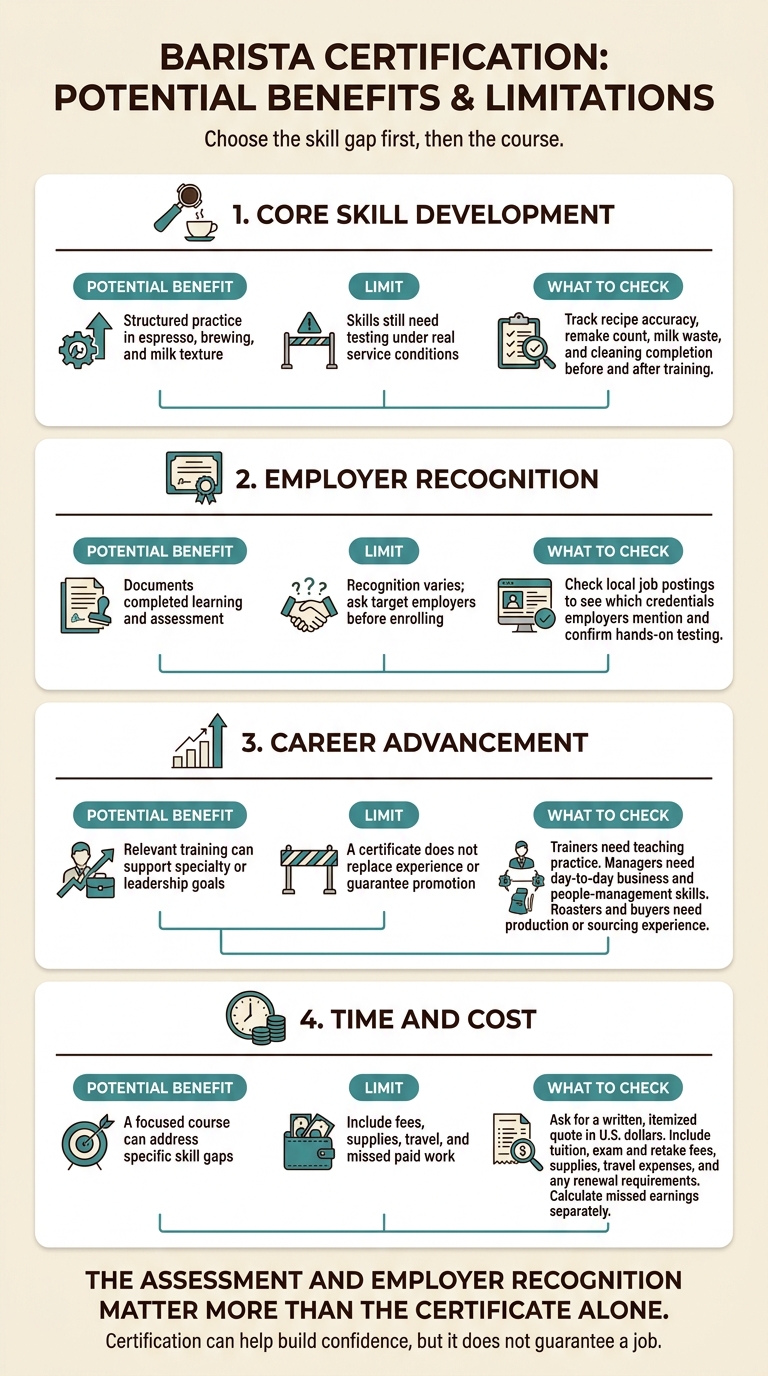
Barista Certification: Benefits vs. Limits
IS BARISTA CERTIFICATION USING SKILLSFUTURE WORTH IT? Review & Vlog | WALK&SEE
sbb-itb-1d31003
More Consistent Coffee Preparation and Service
Certification’s main practical benefit is more consistent work behind the bar. Structured practice builds repeatable habits: follow the recipe, check the result, and adjust your technique. Certification can reveal skill gaps, but consistency still takes daily practice on café equipment.
Skills Used During Café Service
Check that the syllabus covers the skills below and includes hands-on practice on café equipment.
| Skill area | What training develops | Café application |
|---|---|---|
| Espresso | Measuring dose and output in grams, checking shot time, and adjusting grind size | Following house recipes and troubleshooting shots before serving |
| Milk preparation | Controlling texture and checking service temperature in °F | Matching the drink’s required foam and temperature while reducing avoidable remakes |
| Brewing and sensory skills | Controlling brew time, water temperature, and pour rate, plus recognizing flavor differences | Repeating pour-over recipes and spotting cups that need adjustment |
| Workflow and sanitation | Organizing the station and following cleaning and maintenance routines | Keeping preparation and cleaning tasks consistent during busy shifts |
Certification sets a structured performance standard, but equipment and water quality also affect recipe results. The next step is checking whether those skills hold up during service.
How to Track Skill Improvement
Track recipe accuracy, remake count, milk waste, and cleaning completion before and after training. Compare coffee dose and output against the house recipe. Record remakes caused by technical mistakes, measure leftover steamed milk, and track cleaning with daily and weekly checklists. Use those records to decide what needs more practice.
Have a lead barista supervise practice and regularly check espresso flavor and milk texture. Compare similar shifts when possible, noting any changes in staffing, equipment, or order volume. Fewer remakes are a good sign, but they don’t prove that certification caused the improvement.
Job Applications and Career Paths
Once you can perform those skills consistently, certification can help in hiring conversations. A relevant certificate shows structured training and gives you specific points to discuss in interviews.
Employer Recognition and Résumé Details
Recognized credentials such as SCA certificates can help, but many Los Angeles cafés rely on internal training instead. Check local job postings to see which credentials employers mention and whether they require more training.
On your résumé, list the exact course name, level, assessment completed, and completion date. In interviews, highlight skills you can show, such as sensory calibration, TDS measurement, or hands-on experience with specific equipment. Tie each skill to a job task rather than simply naming technical terms.
Moving Into Training, Management, and Specialty Roles
How much a certification helps depends on the role.
| Role | Certification value | Practical skills to demonstrate | Additional experience needed |
|---|---|---|---|
| Entry-level barista | Shows basic coffee training | Espresso workflow, milk texturing, basic calibration | Customer service and basic food safety |
| Lead barista or trainer | Backs up technical knowledge | Sensory calibration, temperature control, flavor analysis | Mentorship and teaching |
| Café manager | Supports coffee knowledge | Waste logs, labor law compliance, financial oversight | Scheduling, budgeting, sustainability reporting |
| Specialty coffee roles | Supports relevant sensory or roasting knowledge | Roast curve analysis, water chemistry, sensory testing | Production roasting, quality control, or direct-trade sourcing |
Choose your next course based on the job, not just the certificate level. Trainers need teaching practice. Managers need day-to-day business and people-management skills. Roasters and buyers need production or sourcing experience.
Confidence and Coffee Community Connections
Explaining Coffee and Helping Customers
Certification builds more than technical skill. It can also help you explain coffee flavors to customers. Lead with flavor words like “floral” or “fruit-forward,” rather than extraction terms. Use origin and processing to add context - not to promise a particular taste.
Start with what the customer enjoys. Match your recommendation to their flavor preferences, then explain the tradeoffs in plain language. Keep questions and explanations short, use troubleshooting knowledge when it helps, and leave room for personal taste. The goal is a helpful conversation, not a technical lesson. That approach works in cuppings and classes, too.
Learning From the Los Angeles Coffee Community
That same knowledge helps you learn from the local coffee scene. Classes, public cuppings, and coffee events give you places to practice describing flavors, compare brewing choices, and build confidence with peers. Before paying, check what a class, membership, or event includes. Treat these as chances to learn, not guarantees of networking.
Use Best Coffee Shops in Los Angeles to find specialty roasters and community-focused cafes. When you visit, keep a low profile, avoid interrupting service, and save questions for a slow moment.
Conclusion: Is Barista Certification Right for You?
Barista certification can help you work more consistently, document assessed skills, build confidence, and support career growth. Its value depends on the program, the assessment, and employer recognition - not the certificate alone.
The next step is to check whether a program fits your goals and what local employers expect. Use the comparison below to weigh its benefits, costs, and limits.
Compare Benefits, Costs, and Limits
| Area | Benefit | Limit to consider |
|---|---|---|
| Core skill development | Structured practice in espresso, brewing, and milk texture | Skills still need testing under real service conditions |
| Employer recognition | Documents completed learning and assessment | Recognition varies; ask target employers before enrolling |
| Career advancement | Relevant training can support specialty or leadership goals | A certificate does not replace experience or guarantee promotion |
| Time and cost | A focused course can address specific skill gaps | Include fees, supplies, travel, and missed paid work |
Ask for a written, itemized quote in U.S. dollars. Confirm tuition, exam and retake fees, supplies, travel expenses, and any renewal requirements. Calculate missed earnings separately. Before paying, check class schedules, equipment access, and instructor qualifications.
Choose a Program for Your Career Goal
Start with one priority: better espresso, sensory specialization, management, or specialty coffee roles. Then compare each program’s curriculum, practical assessment, employer recognition, schedule, and total cost against that goal. For management, look for mentorship and leadership training.
As you narrow your options, weigh cost, recognition, and training quality. Verify prerequisites, how much individual hands-on practice you’ll get, and how the assessment works. Put the skills you need for your next role ahead of the credential itself, and focus on the skill gap you need to close next.
FAQs
Can I get certified without café experience?
Yes. Some Los Angeles cafés and coffee brands offer public classes and training to help you build barista skills, even if you’ve never worked in a café. These programs teach the techniques and standards needed to earn certification.
Is online barista certification worth it?
It depends on your goals. Online barista certification can help establish consistent technical standards, but technical skills alone don’t guarantee career growth or a leadership role. Research on whether certification leads to higher pay or promotions is limited.
Many top-tier Los Angeles coffee shops put more weight on hands-on training, in-house sensory labs, and mentorship than on outside credentials. Local experience and employer-supported training often matter more.
How long does barista certification take?
Barista certification time depends on the program’s focus and depth. Some professional certification tracks include 40 hours of intensive training. Specialized programs may require up to 80 or even 160 hours to cover topics such as sensory calibration, milk texturing, and flavor architecture.
Training ranges from basic skills to advanced technical work. Check with individual cafes or training providers for the exact duration and curriculum.