Fair Trade uses certification; direct trade relies on buyer–producer relationships. I look beyond either label: check who grew the coffee, what the buyer paid, and how much they purchased.
Fairtrade sets a price floor and a producer-controlled premium. Direct trade has no universal price floor or certification, though buyers may pay more for quality. Coffee can use both models - and neither guarantees higher take-home income.
Quick Comparison
| What I check | Fairtrade | Direct trade |
|---|---|---|
| Producer access | Smallholder cooperatives and producer groups | Farms, estates, or cooperatives |
| Verification | Third-party compliance audits | Buyer reports; outside checks vary |
| Price protection | Minimum price plus a separate premium | Negotiated price; no standard floor |
| Community funding | Required producer-controlled premium | Depends on the buyer |
| Quality payments | No guaranteed specialty score | Quality may earn higher prices |
| Buyer commitments | Certification does not guarantee sales | Repeat purchases depend on agreed terms |
| Shipping and financing | Intermediaries may remain | Intermediaries may remain |
| Farmer income | Costs, deductions, and sales volume matter | Costs, deductions, and sales volume matter |
For a concrete example, the article’s August 1, 2023, Fairtrade schedule lists a $1.80-per-pound floor for washed Arabica, plus a $0.20 premium. That export-port price is <u>not the farmer’s take-home pay</u>.
Before buying, I check dated certification or sourcing records, farm-gate versus export-port prices, payment routes, purchase volumes, and written terms. Organic status needs a separate check. The same questions apply at a Los Angeles café: a shop listing or a higher bag price doesn’t verify sourcing.
Fair Trade vs. Direct Trade Coffee (Podcast: 'Coffee &' - Ep. 5)
sbb-itb-1d31003
How Each Sourcing Model Works
Fair Trade is a broad category; Fairtrade is one certification system within it. Each program sets its own pricing and compliance rules. The main differences lie in how prices, contracts, and verification work.
Fair Trade Certification and Producer Groups
Under Fairtrade, farmers usually sell through a cooperative or producer organization to qualify for the Fairtrade Minimum Price and Premium. These groups connect their members with buyers. Other Fair Trade programs may have different requirements.
Fair Trade certification does not mean organic certification. Check each claim separately.
Direct Trade Relationships Between Producers and Roasters
Roasters buy directly from farms, cooperatives, or producer groups, though exporters or importers may still handle shipping and financing. “Direct” describes the producer–roaster relationship - not a supply chain with no intermediaries.
Direct trade has no universal certification or fixed definition. Prices, quality standards, and commitments to repeat purchases vary by roaster. Check whether the roaster supports quality, negotiates prices directly, and commits to future purchases.
Key Differences Between Direct Trade and Fair Trade
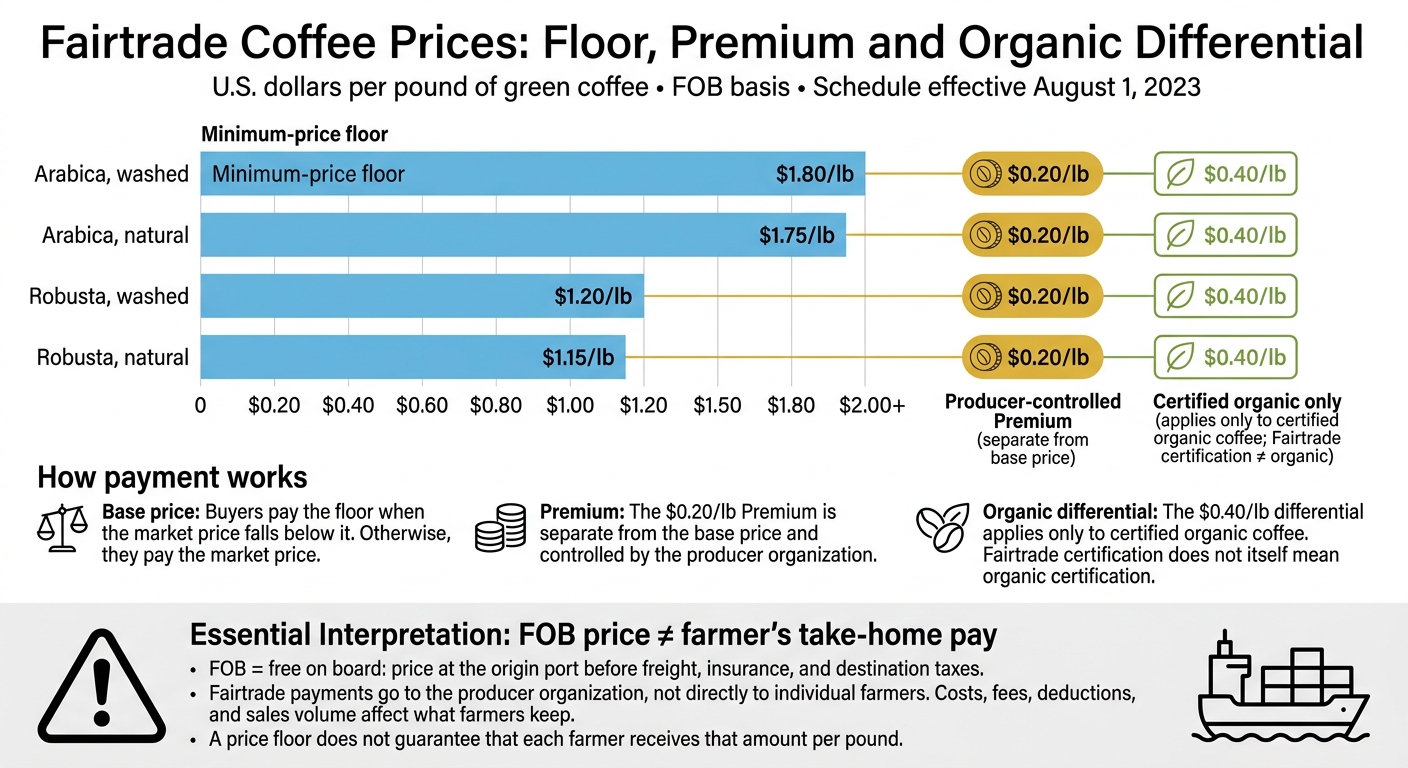
Fairtrade Coffee Prices: Floor, Premium and Organic Differential
Fairtrade is certification-based; direct trade is relationship-based. They differ in how they document prices, transparency, and accountability. The models can overlap, but they aren't interchangeable. Those differences affect how much money reaches farmers - and what buyers can check.
Here's what each model requires, what it leaves open, and what buyers should verify.
| Feature | Fairtrade: certification requirements | Direct trade: buyer practices |
|---|---|---|
| Sourcing | Smallholder cooperatives and producer groups | Individual farms, estates, or cooperatives |
| Verification | Third-party compliance audits, including by FLOCERT | Roaster-disclosed reports or claims |
| Pricing | Minimum-price floor plus a fixed premium | Negotiated prices; no standard floor |
| Intermediaries | Cooperative management; logistics intermediaries may remain | Fewer intermediaries, though exporters/importers may still handle logistics |
| Producer access | Organized smallholder groups | Any farm size or type |
| Transparency | Audited compliance with global standards | Disclosure varies by roaster |
| Community investment | Mandatory, producer-controlled Fairtrade Premium | No standard premium; support varies by buyer |
| Quality incentives | No guaranteed specialty quality score | Higher quality can earn higher premiums |
| Risk protection | Price floor protects against market crashes | Relationship-based stability, not a price floor |
Fairtrade Pricing: Minimum Price, Premium, and Organic Differential
The Fairtrade pricing schedule sets these amounts in U.S. dollars per pound of green coffee, on an FOB basis, effective August 1, 2023.
| Coffee type | Minimum-price floor | Producer-controlled Premium | Organic differential | Effective date |
|---|---|---|---|---|
| Arabica, washed | $1.80/lb | $0.20/lb | $0.40/lb | August 1, 2023 |
| Arabica, natural | $1.75/lb | $0.20/lb | $0.40/lb | August 1, 2023 |
| Robusta, washed | $1.20/lb | $0.20/lb | $0.40/lb | August 1, 2023 |
| Robusta, natural | $1.15/lb | $0.20/lb | $0.40/lb | August 1, 2023 |
Buyers pay the floor when the market price falls below it. Otherwise, they pay the market price. The premium is separate from the base price, and the producer organization controls it. The organic differential applies only to certified organic coffee.
FOB means “free on board”: the price at the origin port before freight, insurance, and destination taxes. Fairtrade payments go to the producer organization, not directly to individual farmers. So the floor doesn't guarantee that each farmer receives that amount per pound.
A price floor matters. But when assessing a direct-trade claim, documentation matters more.
Verify Direct-Trade Claims
Direct trade is not a protected certification term. On its own, the label guarantees no minimum price, labor standards, or independent audits. Ask for evidence tied to the specific coffee:
- Producer identity: Is the farm, estate, or cooperative named?
- Price basis: Is the disclosed price farm-gate or FOB?
- Intermediaries: Which exporters or importers handled the coffee?
- Payment route: Who received payment, and how did it reach the producer?
- Contract terms: What pricing and future-purchase commitments were agreed?
- Purchased volume: How much did the buyer purchase from that producer during the stated period?
- Relationship length: How many years has the roaster purchased from that source?
How Each Model Affects Farmer Income
Neither model guarantees higher net income. Fair Trade sets price protections, while direct trade depends on buyer terms. Under both models, farmers’ income depends on costs, sales volume, and deductions.
| Income factor | Fair Trade: strengths and limits | Direct trade: strengths and limits |
|---|---|---|
| Income security | A price floor supports certified sales, but does not cover every sale a farmer makes. | Security depends on negotiated prices and repeat orders. |
| Potential earnings | Sales volume and producer-group deductions affect farmers’ earnings. | Quality premiums can increase earnings, but may cover only part of a harvest. |
| Transparency | Group records show deductions. | Traceability shows where coffee comes from, not farmers’ take-home pay. |
Coffee Purchase Prices vs Farmer Income
Purchase price is not net income. What farmers keep depends on production costs, fees, deductions, and how much coffee they sold at that price.
Farmer Bargaining Power and Buyer Commitments
Price floors and buyer relationships give farmers different forms of leverage. To assess either model, look at who sets the terms, who pays the costs, and how much coffee the buyer has committed to purchase.
| Issue | Fair Trade protections and practical limits | Direct-trade commitments and practical limits |
|---|---|---|
| Price negotiation | The certified floor sets a baseline; producer groups negotiate sales above it. | Prices are negotiated, with no universal safety net if the relationship ends. |
| Purchase stability | Certification alone does not guarantee a buyer for the entire harvest. | Repeat orders help, but past purchases do not guarantee future volume. |
| Accountability | Members need clear deductions, spending records, and a meaningful voice. | Written terms provide stronger evidence than informal promises of continued support. |
Check whether written agreements spell out prices, purchase volumes, payment terms, and quality requirements. Then look at how much farmers received after deductions and how much coffee the buyer purchased. A certification logo or a long buyer relationship cannot answer those questions on its own.
What to Check Before Buying Coffee
Use these checks to assess sourcing claims - not just the branding.
Read Labels and Sourcing Reports
Look for a recognized certification seal, then check any available certification records or sourcing reports. For direct trade, the bag or report should name a farm, estate, or cooperative. A country name alone is too vague.
Check the report date, harvest or purchase date, contract terms, and any third-party verification. An ethical sourcing claim alone doesn’t tell you the price, volume, or contract terms.
Compare prices using the same currency, unit, and stage of sale. Farmgate is the price paid to the farmer; FOB is the price paid at the export port. Look for purchased volume in pounds or bags, plus dated records of repeat orders - not just a claim that the buyer purchases repeatedly.
Find Los Angeles Cafés and Ask About Their Coffee
The same checks apply when you buy coffee at a local café.
Best Coffee Shops in Los Angeles lists Los Angeles coffee shops by neighborhood and atmosphere. It can help you find cafés and specialty roasters, but it doesn’t verify their sourcing claims.
Ask the roaster for records showing the certification program, producer, price basis, purchased volume, and repeat orders. Missing details limit what you can verify, but they don’t prove poor sourcing.
Conclusion: Choose Coffee Based on Verified Sourcing
Fair Trade provides third-party standards and price protections. Direct trade relies on documented producer relationships and negotiated prices. Some coffees use both models.
Choose the coffee with the clearest records of price, volume, and payment. Here’s what to check:
| What to verify | Evidence |
|---|---|
| Fair Trade certification | Auditable certification records. |
| Named producer relationships | Written purchase terms. |
| Both models | Certification alongside roaster-published sourcing and relationship records. |
Neither model guarantees farmer prosperity. Labels alone don’t account for farm costs, fees, or market pressure. Look for verified payments, clear pricing, and documented buyer commitments.
FAQs
How can I tell which coffee better supports farmers?
Choose roasters that are open about their sourcing and work directly with farmers. Direct trade often means paying farmers a premium for quality beans and keeping supply chains traceable.
At local cafes, ask where the beans come from and how they’re sourced. Shops that focus on ethical, traceable coffee are more likely to explain how their purchases support farming communities.
What if a roaster won’t share sourcing records?
When a roaster won’t share sourcing records, it’s harder to check their supply chain and ethical claims. Without those records, you may not be able to verify whether the coffee is ethically sourced or farmers receive the premiums they were promised.
If transparency matters to you, look for shops that make traceable sourcing a priority. Choosing those shops can help support more equitable coffee practices.
Is ethically sourced coffee worth a higher price?
Ethically sourced coffee is often seen as worth the higher price. It supports quality from seed to cup and farming practices that protect the land over time. That premium also helps roasters build long-term relationships with producers and offer flavorful, traceable, responsibly grown coffee.
Many of Los Angeles’s top roasters put these practices first. Our curated directory, Best Coffee Shops in Los Angeles, highlights cafes that specialize in ethically sourced beans.